
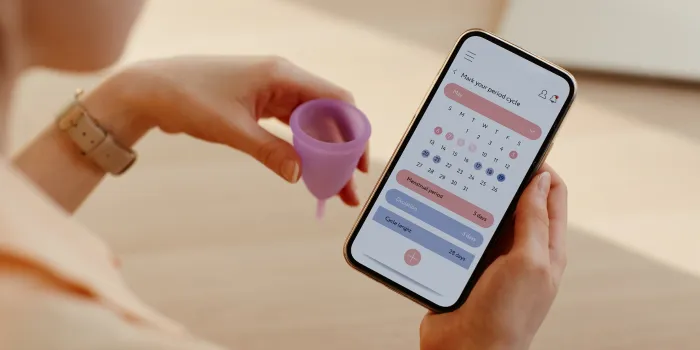
Tracking menstruation provides useful information. It enables women, girls, and people who have the potential to menstruate to have greater visibility into their periods so they can make more informed choices about their health.
For those with bleeding disorders, period tracking has medical and quality-of-life implications.
"In the bleeding disorders patient population, menstrual tracking is very important for recall,” says Lisa Oldham, M.D., a gynecologist in the hemophilia and thrombophilia care center at Rush University Medical Center in Chicago. “It’s a helpful qualitative measure for us, but it also helps us to try to quantify blood loss, and frequency and regularity of bleeding.”
Period-tracking applications have become an increasingly popular way to log menstruation cycles, with hundreds of apps on the market downloaded hundreds of millions of times worldwide.
However, the sensitive nature of stored data coupled with recent federal legislation changes — namely, Roe vs. Wade’s overturn in 2022 — have many people concerned about health information privacy.
What Doctors Really Need from Tracking
Period tracking is a valuable tool that can be used to determine whether a bleeding disorders treatment regimen is effective or not, and whether there might be other gynecologic issues behind the bleeding irregularities.
Simply asking, “Do you feel your period is heavy?” is a good starting point, but it doesn’t provide the whole story, which varies from person to person, Oldham says. That’s where data from period tracking can assist.
“When you give more detail, it’s easier to understand what you’re experiencing,” she says. “It also helps you to tie in all of the other symptoms that you’re having — for example, pain, mood, how it’s creating a problem at school or work — and we can make a plan based on that.”
Tracking is most useful when it helps you answer these questions during a provider visit:
- Are your periods regular or irregular? Do you get two cycles a month, or do you skip several months between cycles?
- How many days do the cycles last? How many of those days are heavy?
- How many menstrual products are you using per day? What is the size and the absorbency?
- Are you passing blood clots? How big are the blood clots?
- Are you gushing through clothes?
- Are you waking up at night because of heavy bleeding?
- Are you feeling tired?
- Have you gone to the ER or received a blood transfusion?
- Has it affected your school or your work?
- What is your mood like?
The Privacy Gap Most People Don’t See
People are concerned about the privacy of their health records in the provider’s office, yet that concern doesn’t seem to extend to apps, Oldham says. They are accustomed to using apps for many aspects of their life — from fitness to finance — and they’re willing to enter private information believing the benefits outweigh the risks.
“I don’t know if there is a false sense of security or if there just isn’t as much worry about this,” she says.
Many entities, such as health care providers and health insurance plans, are required by law to safeguard your protected health information. Unfortunately, this law generally does not extend to information that you enter into mobile apps.
Some apps strive to protect user data, and others not so much. For example, those that are ad-supported might actively share user information to third parties as part of their business model. How data is stored and shared ultimately depends on company policies.
Clue, a popular period-tracking app, stands behind a commitment to data privacy. Another popular app, Flo, settled a class action lawsuit over allegations that it shared users’ health data with third parties; today, the app’s anonymous mode decouples health information from the user. Apps such as Euki store data locally, so it’s not shared.
Why Period Data Is Particularly Sensitive
Although many apps track seemingly inconsequential data such as step counts, calorie consumption, or sleep time, the stakes are higher with period trackers.
The root of concern lies in the sensitivity of the tracked data and how it could reveal patterns of pregnancy and other aspects of reproductive health. In states that are criminalizing abortion, for example, the information collected by period-tracking apps could become a safety risk.
“If they’re putting their protected health information into a server that is not their own private phone — if it’s in the cloud or with some other private company that isn’t held to the same standards that hospitals are — then I would be very leery about giving any information that they wouldn’t want stolen,” Oldham says.
“If it’s just basic information without name, demographics, or any medical-related issues, then I think that’s fine,” she says. “But many of these apps are tied to products, especially the ones that people use for fertility, which even people with bleeding disorders will use, because those are the apps that are available.”
What to Do Before Using a Period Tracker App
Given that menstruation data is beneficial in managing bleeding disorders, the goal is not to stop tracking, but rather to be more thoughtful about it.
“People should be very mindful to read the fine print about who has access to that information,” Oldham says. “And potentially just don’t give it.”
Look through the app’s privacy policy for information about who owns the data, how it’s protected, and where it’s shared. Trustworthy privacy policies are easy to read, are specific to the organization, and include contact information. (Consumer advocate PIRG has a thorough report on how to read a privacy policy.)
Pay attention to the sections in the privacy policy labeled “data we collect about you” and “how we use your information,” or some variation of those phrases. Search the policy for keywords such as “targeted/personalized advertising,” “marketing,” “sell,” “share,” and “third parties” or “affiliates.”
See if you’re able to enter information anonymously, or if you can permanently delete your data.
To help protect your privacy in period-tracking apps, follow these tips:
- Don’t use a social media account to sign in, as it may link your account data.
- Create a password specifically for the app, and consider a unique email, to limit exposure to a breach among your accounts that share login credentials.
- Disable ad tracking, which prevents developers from seeing your activities across apps.
- Adjust privacy settings to limit data sharing.
- Review app permissions and deny access to any data categories you don’t want the app to have.
Ultimately, if you decide to use a period tracking app, only enter information that will help you learn more about yourself and how to better manage your condition with your care team. Also, be wary of the feedback you get from apps, as it might depend on algorithms from data trends and not individual situations.
“If you are relying on the app to tell you a story about your own personal experience, it’s going to be incorrect,” Oldham says. “But if you use it as a journal to chronicle your daily experiences moment to moment, then that is going to be an accurate story.”